
1xBet KYC
1xBet KYC explained: required documents, common rejection reasons, and average processing time to get your account verified.
1xBet KYC verification is the identity check process that confirms a bettor's name, age, and payment details before withdrawals are approved. The platform compares submitted documents against account registration data and locks withdrawal functions until the match is confirmed.
Completing 1xBet KYC verification means uploading a government-issued ID through the account settings panel, then waiting for the compliance team to approve or reject the submission. The process starts from the account dashboard, not from the deposit or withdrawal page.
The documents accepted for 1xBet KYC verification follow a short list. Typically, bettors need to submit a valid passport or national ID card along with a selfie holding that document, and in some cases a recent utility bill to confirm their address. File format and photo quality standards affect whether the upload passes the automated check.
Most 1xBet KYC verification failures come down to document quality. Common rejection reasons include a blurry photo, an expired document, or a name on the ID that doesn't match the name used during registration. Mismatched details trigger a manual review that extends the waiting period.
Processing times for 1xBet KYC verification depend on the submission itself. KYC review times vary, ranging from a few hours to a few business days depending on document clarity and current review volume. Bettors check status directly inside the account verification tab without contacting support first. The sections below from 1XBET break down what KYC verification means on the platform, the exact steps to submit documents, and the full list of accepted paperwork.
What is 1xBet KYC verification?
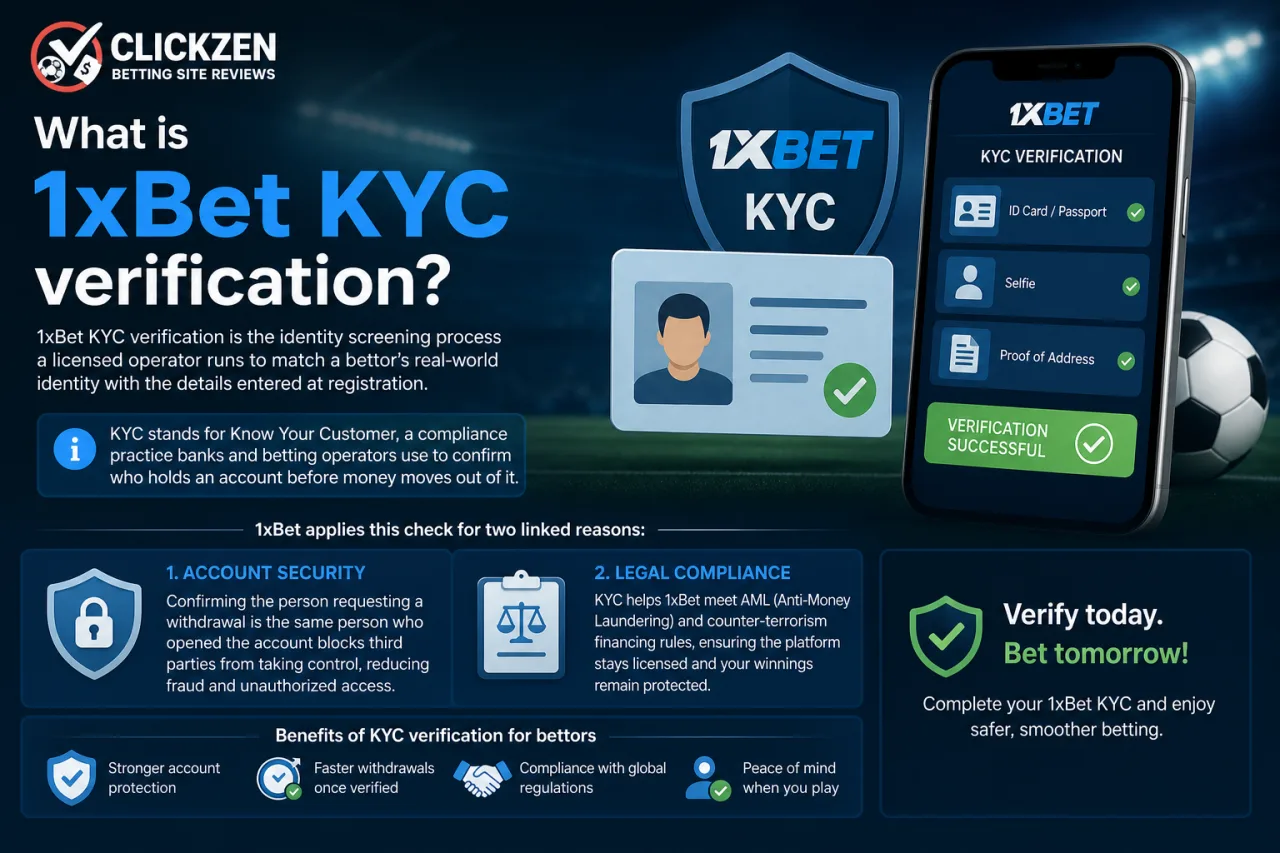
What is 1xBet KYC verification
1xBet KYC verification is the identity screening process a licensed operator runs to match a bettor's real-world identity with the details entered at registration. KYC stands for Know Your Customer, a compliance practice banks and betting operators use to confirm who holds an account before money moves out of it.
1xBet applies this check for two linked reasons. One is account security: confirming the person requesting a withdrawal is the same person who opened the account blocks third parties from draining a balance that isn't theirs.The other is regulatory compliance: gambling operators holding a license are generally required to verify customer identity and screen for underage users as part of anti-money-laundering rules.
The sections below cover what counts as an accepted document, why certain submissions get rejected, and how long the review usually takes.
Why does 1xBet require KYC from new bettors?
Yes, 1xBet requires KYC from every bettor who wants to withdraw funds, but the check isn't forced at registration itself. The requirement sits on the withdrawal step rather than the sign-up form, and a few specific triggers decide when the operator actually asks for documents.
Three conditions push verification forward.A bettor requesting a withdrawal above a certain amount may get flagged for document upload before the payout clears. Claiming a deposit bonus or free bet also triggers a check, since the operator needs to confirm the account holder's age and identity before releasing bonus-linked funds. Unusual account activity, such as repeated login locations or payment methods that don't match the registered name, prompts a manual review outside the normal schedule.
The underlying reason stays the same across all three triggers. 1xBet operates under licensing rules that require customer identity checks and underage-user screening before money leaves an account. A bettor who never withdraws or claims a bonus can use the account without submitting documents, but any payout request reopens the requirement.
How to complete 1xBet KYC verification step by step?
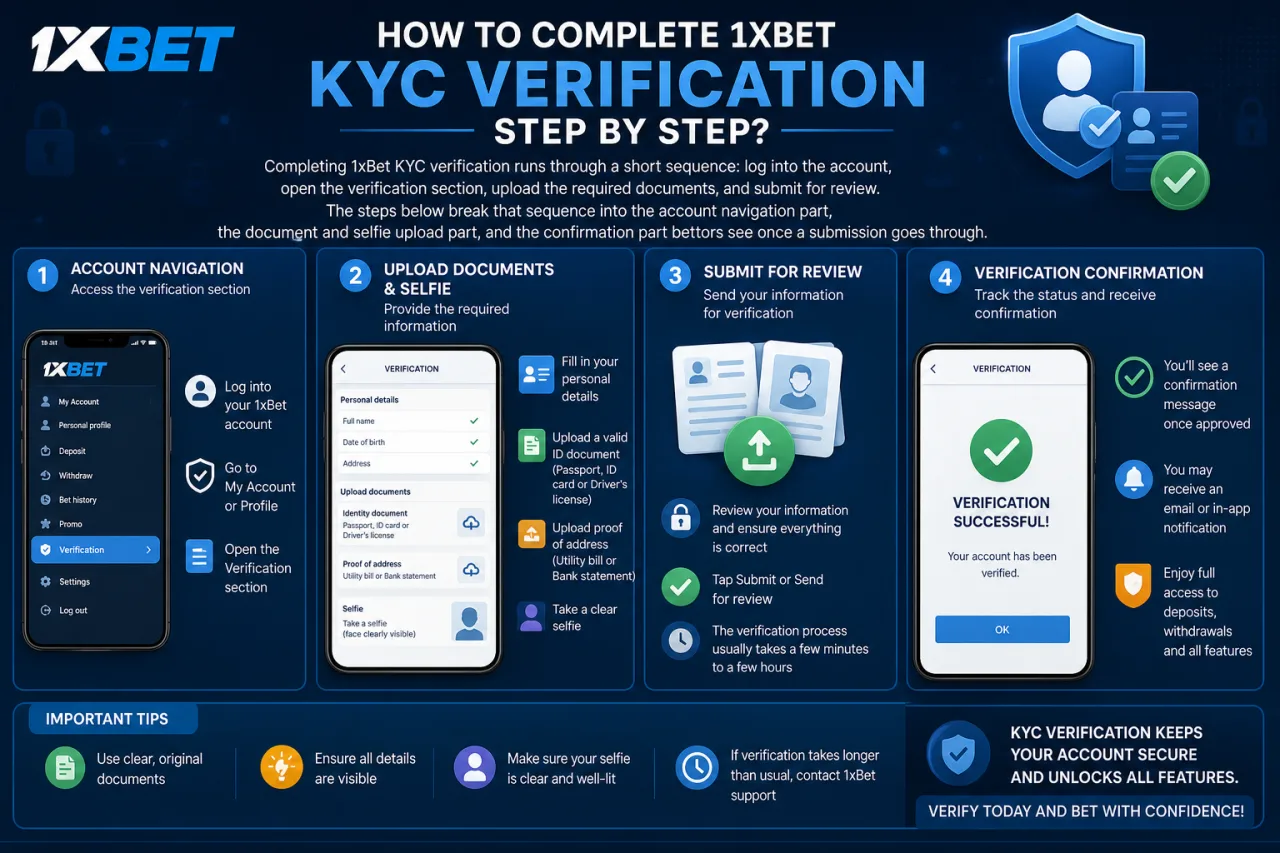
How to complete 1xBet KYC verification step by step
Completing 1xBet KYC verification runs through a short sequence: log into the account, open the verification section, upload the required documents, and submit for review. The steps below break that sequence into the account navigation part, the document and selfie upload part, and the confirmation part bettors see once a submission goes through.
Where in the account settings is the verification section located?
The verification section sits inside Profile settings, under a tab usually labeled "Verification" or "Identification" on both the desktop site and the mobile app. The exact label and menu depth differ slightly between the two versions, though the destination is the same account area.
On the desktop site, a bettor logs in, clicks the account name or avatar in the top right corner, opens "My Account" or "Settings," then selects the "Verification" tab from the left-side menu list. The upload fields for ID and selfie photos appear directly on that page once selected.
On the mobile app, the path runs through the bottom navigation bar: tap the profile icon, open "Personal Data" or "Settings," then scroll to "Verification" or "Document Upload." Some app versions place a verification banner directly on the main account screen when a submission is pending or rejected, which shortcuts the menu navigation entirely.
Bettors using the mobile browser instead of the app follow the same path as the desktop site, since the layout mirrors it with a collapsed menu icon replacing the top bar.
How to upload documents correctly for 1xBet verification?
Uploading documents correctly for 1xBet verification means matching the file format and size to the platform's requirements, photographing under even light, and submitting through the verification tab on either web or app. That requirement covers four separate points:
File format
File size
Photo quality
Submission channel
1xBet accepts standard image and PDF files for ID and address documents, typically JPEG, PNG, or PDF, with uploads capped at a set file size limit per document. Accepted file formats and maximum upload size can vary by region and are shown directly on the upload page at the time of submission.
Photo quality affects approval more than any other factor at this stage. A bettor should photograph the full document on a flat, dark background with no glare, keep all four corners visible in frame, and avoid cropping out the photo page or expiry date.
The submission channel changes only the navigation, not the requirement itself. On the web version, the file picker opens a browser upload window tied to the device's storage. On the app, the same step offers a direct camera capture option alongside the gallery upload, which skips a transfer step for bettors photographing the document on the spot.
What documents are required for 1xBet KYC verification?
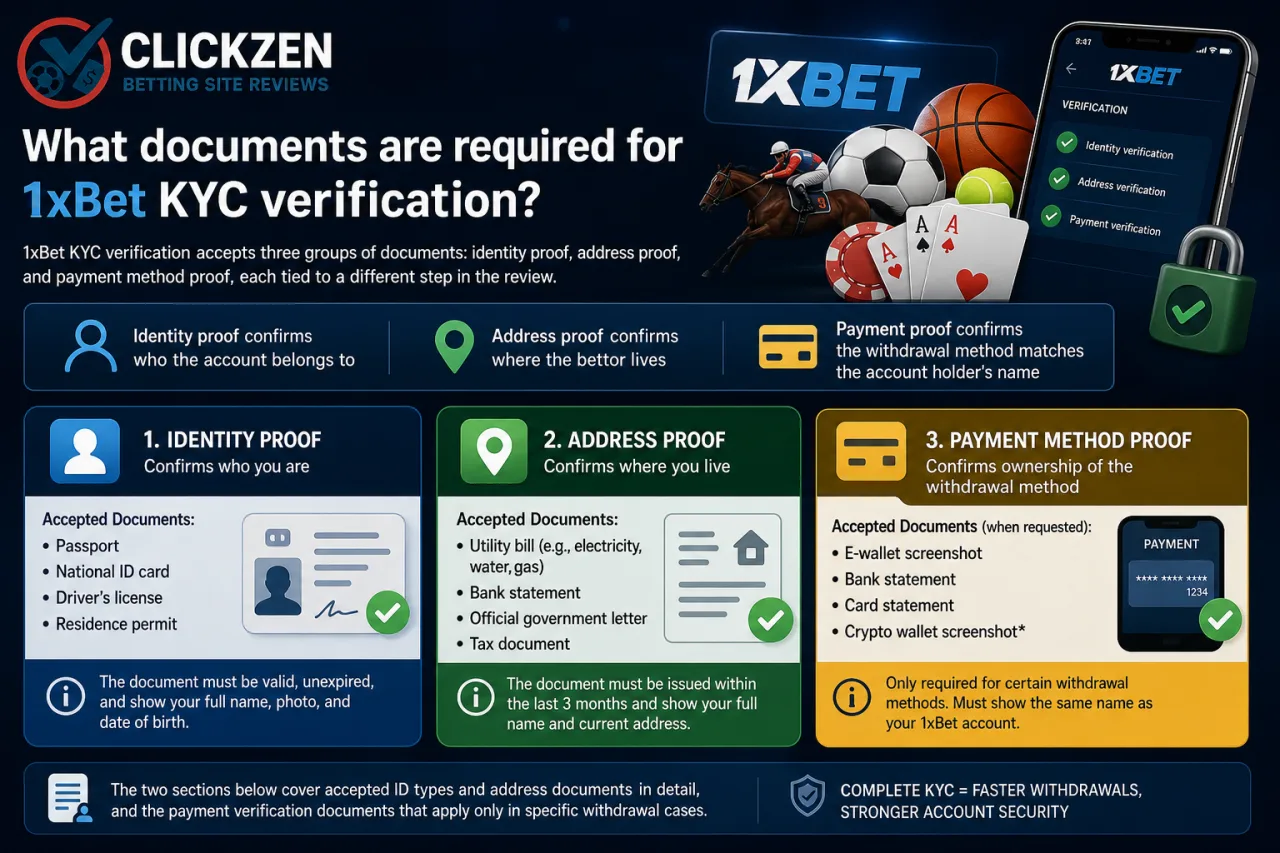
What documents are required for 1xBet KYC verification
1xBet KYC verification accepts three groups of documents: identity proof, address proof, and payment method proof, each tied to a different step in the review. Identity proof confirms who the account belongs to, address proof confirms where the bettor lives, and payment proof confirms the withdrawal method matches the account holder's name. The two sections below cover accepted ID types and address documents in detail, and the payment verification documents that apply only in specific withdrawal situations.
Which identity documents does 1xBet accept?
1xBet accepts three identity document types for KYC verification: a passport, a government-issued national ID card, or a driver's license, as long as the document is current and the photo page is fully legible. Each type goes through the same compliance check but carries slightly different conditions on validity and photo clarity.
Passport: the photo page must clearly show full name, date of birth, photo, and expiry date, with the document still valid at the time of submission. An expired passport typically leads to rejection during the compliance review, regardless of how clear the scan is.
National ID card: the printed name must mirror the one entered at registration exactly, including middle names and spelling. This is the same name-matching rule applied to passports.
Driver's license: accepted as a substitute in regions where it carries a photo and a government-assigned ID number. Some reviewers request a second document if the license lacks a printed address.
Bettors submitting any of the three should avoid photocopies or screenshots, since the compliance team asks for a direct photo or scan of the physical original.
Is proof of address always needed for verification?
No, proof of address is not always needed for 1xBet KYC verification; it becomes a requirement mainly when a withdrawal amount crosses a certain threshold or when the compliance team flags an account for extra review. Identity documents cover most standard checks on their own, and address proof gets added as a second layer only in specific situations.
A withdrawal request above a set payout limit typically triggers a request for a utility bill or bank statement, since larger transfers draw closer scrutiny under the operator's anti-money-laundering process. The exact withdrawal amount that triggers an address check is not published by 1xBet and can vary by account history and region.
A bank statement or utility bill submitted for this purpose needs to show the bettor's full name and current address, dated within a recent period, and match the name already confirmed through the ID document. A statement or bill older than that window, or one listing a different address than the one on file, goes back for resubmission. Bettors who stay under the payout threshold and show no flagged activity generally complete verification with identity documents alone.
Why does 1xBet KYC verification fail or get rejected?
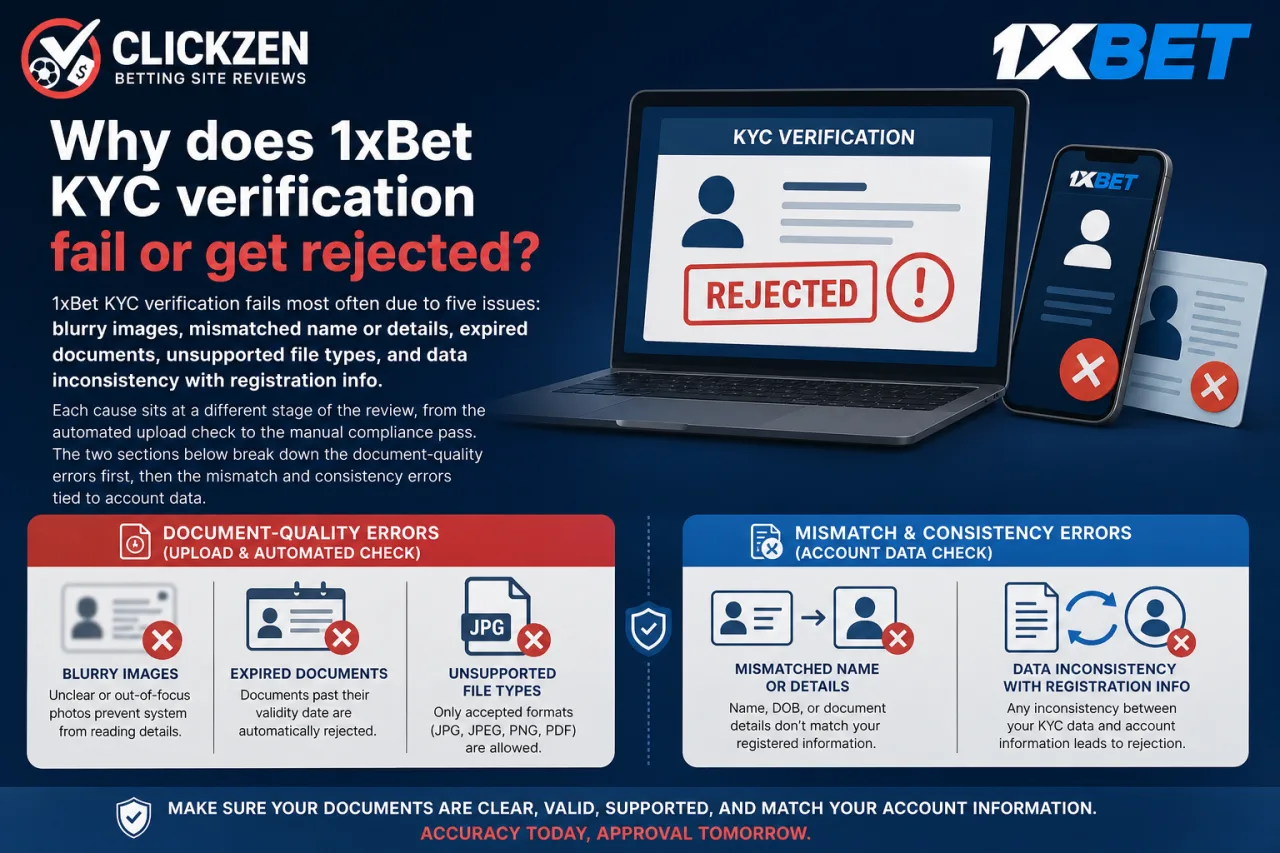
Why does 1xBet KYC verification fail or get rejected
1xBet KYC verification fails most often due to five issues: blurry images, mismatched name or details, expired documents, unsupported file types, and data inconsistency with registration info. Each cause sits at a different stage of the review, from the automated upload check to the manual compliance pass. The two sections below break down the document-quality errors first, then the mismatch and consistency errors tied to account data.
What to do if 1xBet rejects your verification documents?
A rejected 1xBet KYC submission requires three steps: reading the rejection reason in the account verification tab, fixing the specific flagged issue, and re-uploading the corrected document for a fresh review. The platform doesn't lock the account permanently after a rejection; it reopens the upload field so the same bettor can submit again without creating a new account.
The rejection notice names the problem directly, whether it's a blurry scan, a mismatched name, or an expired ID, and that message is the starting point for correcting the resubmission.
The fix matches the cause. A blurry or cropped photo gets replaced with a new scan taken on a flat surface under even light. A name mismatch between the ID and the registration details goes to support first, since the account name may need correcting before the document matches. An expired document requires a current replacement, such as a renewed passport or a different accepted ID type.
Bettors who can't identify the exact problem from the rejection message contact support through live chat or the help center listed in the account settings, where a compliance agent reviews the submission history and confirms what to change before the next upload.
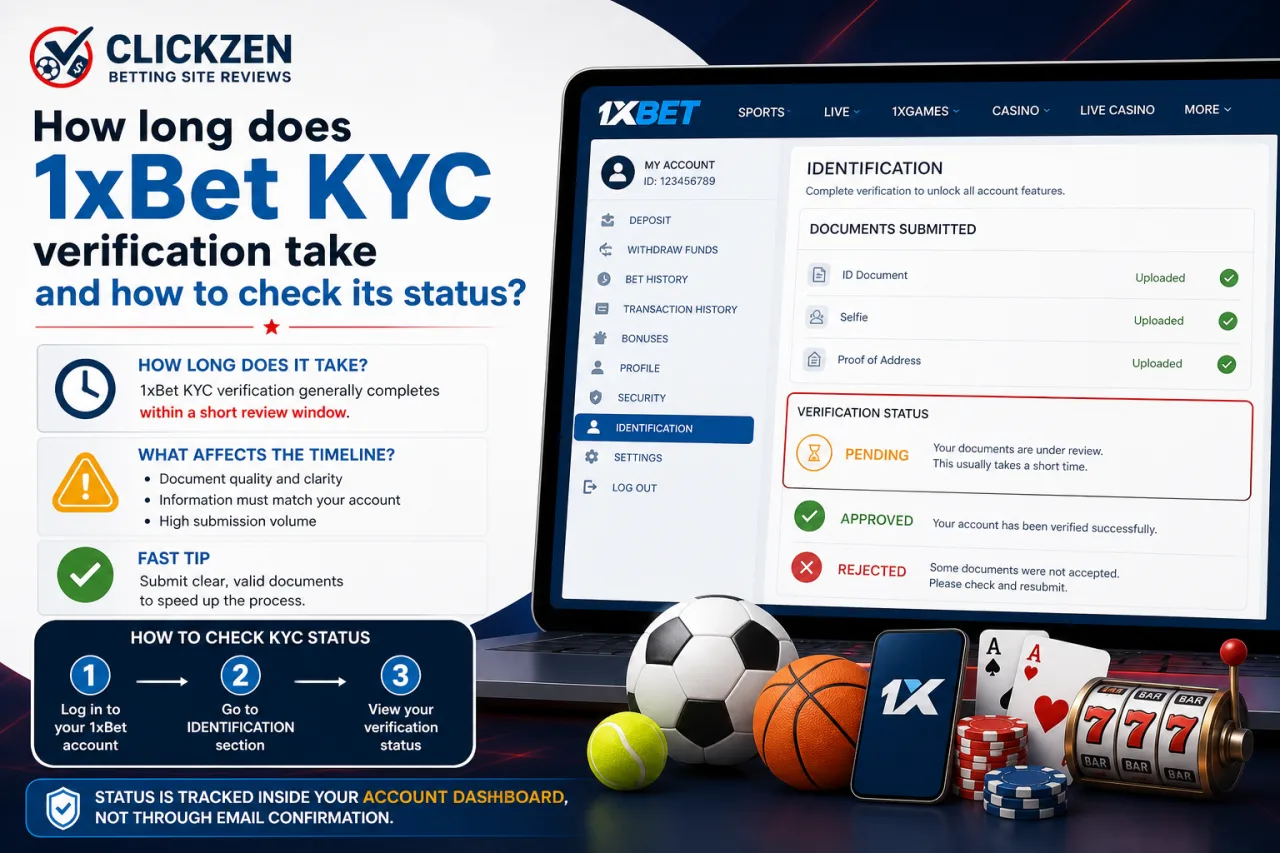
How long does 1xBet KYC verification take and how to check its status?
How long does 1xBet KYC verification take and how to check its status
1xBet KYC verification generally completes within a short review window, though exact timing depends on document quality and submission volume, and status tracking happens inside the account dashboard rather than through separate email confirmation. The sections below cover the typical duration bettors should expect, what stretches that timeline, and where the pending, approved, or rejected status actually shows up on the account.
Where can bettors check their verification status on 1xBet?
Bettors check their verification status inside the account profile, under the same Verification tab used to upload documents, where the submission shows as pending, approved, or rejected. That status indicator stays current without any extra action from the bettor, since it updates automatically once the compliance team finishes a review.
Email updates back up the in-account status for bettors who don't log in right after submitting. A confirmation message arrives when a document is received, and a second message follows once the review closes, either clearing the account or flagging what needs fixing.
Support chat offers a third checkpoint when the profile status hasn't changed after a longer wait than expected. A live agent pulls up the submission record directly and confirms whether it's still queued or stuck on a specific document issue, which saves a bettor from resubmitting blind.
What are advanced verification scenarios on 1xBet beyond standard KYC?
1xBet runs enhanced due diligence on a small set of rare cases beyond standard KYC, grouped into three scenarios: large-withdrawal triggers, source-of-funds checks, and repeated verification requests for high-volume bettors. Each scenario adds a review layer on top of the identity and address documents already covered, and applies only when an account's transaction pattern crosses a specific line rather than at routine login or deposit.
What is source-of-funds verification and when does 1xBet request it?
Source-of-funds verification is a compliance check that asks a bettor to prove where the money funding an account actually came from, distinct from the identity documents already covered. Instead of confirming who holds the account, this check confirms whether the deposited or withdrawn amount matches a legitimate income source such as a salary, business revenue, or a bank transfer the bettor can document.
1xBet requests it mainly when a withdrawal or deposit crosses a value that triggers enhanced due diligence, or when account activity pattern looks unusual against the bettor's normal transaction history. The exact transaction value that triggers a source-of-funds request is not published by 1xBet and can vary by region and account history.
Bank statements, payslips, or a letter from an employer typically satisfy this request, submitted through the same verification tab used for identity documents.
Can verification requirements differ by country for 1xBet bettors?
Yes, verification requirements differ by country for 1xBet bettors, since the operator runs under separate licenses across markets and each license sets its own documentation rules. A jurisdiction with stricter anti-money-laundering rules can demand address proof or source-of-funds checks earlier than a market with lighter licensing conditions.
Document type requirements shift first. Some regions accept a driver's license as standalone ID proof, while others require a passport or national ID specifically and treat a driver's license as secondary support only.
Review depth shifts second. A bettor registered under a license with tighter payout monitoring sees lower withdrawal thresholds before address or source-of-funds documents get requested, compared to a bettor under a license with looser thresholds. Document requirements and withdrawal thresholds can differ by licensing jurisdiction, and 1xBet does not publish a single country-by-country comparison of these rules.
Bettors checking which rules apply to their account confirm the exact document list directly inside the verification tab rather than assuming a global standard applies everywhere.
Conclusion
A bettor planning a withdrawal confirms three things before submitting anything: the ID photo shows all four corners under even light, the printed name matches registration data exactly, and the document is still within its validity date. Those three checks catch the causes behind most rejections covered above. Address proof and source-of-funds paperwork only enter the picture once a payout crosses a threshold or account activity looks unusual, so a bettor under that line uploads identity documents once and tracks status directly in the Verification tab.