
Responsible Gambling
This website is committed to promoting responsible gambling and providing readers with clear, balanced information about the risks associated with sports betting, casino gaming, and other gambling products. This policy is published on 1xbet, an independent informational website.
Gambling should be treated as entertainment, not as a way to generate guaranteed income, recover financial losses, repay debts, or solve financial problems.
Every form of gambling involves financial risk. No betting strategy, bonus, system, prediction, statistical model, or gambling platform can guarantee long-term profit.
This page explains the responsible gambling principles we follow, the warning signs users should be aware of, and the tools that may help adults maintain greater control over their gambling activity.
This website is an independent informational and editorial resource about 1xBet. We are not the official 1xBet website and cannot control player accounts, deposits, withdrawals, gambling limits, or self-exclusion settings on the 1xBet platform.
Our Approach to Responsible Gambling
Our content about 1xBet, sports betting, casino games, bonuses, payments, and related topics is provided for informational and educational purposes.
Our content should never encourage readers to:
Gamble with money they cannot afford to lose
Borrow money to gamble
Chase previous losses
Treat gambling as a regular source of income
Ignore personal spending or time limits
Continue gambling when it negatively affects wellbeing
Believe that any strategy or system guarantees profit
Our goal is to explain gambling products and platform features clearly while acknowledging the financial and personal risks involved.
Gambling Always Involves Risk
Betting and casino outcomes are uncertain.
Even experienced users can lose money, and past results do not guarantee future outcomes.
Odds, statistics, bonuses, strategies, predictions, or analysis cannot eliminate the underlying financial risk of gambling.
Before gambling, users should understand that they may lose some or all of the money they wager.
Only money that is genuinely affordable to lose should ever be used for gambling.
Gambling Should Remain Entertainment

Gambling should remain an optional recreational activity.
It should never interfere with essential responsibilities such as:
Rent or mortgage payments
Household bills
Food and essential purchases
Education expenses
Debt repayments
Savings
Employment
Personal relationships
Physical or emotional wellbeing
Gambling should not be viewed as an investment, a guaranteed income source, a method of paying debts, or a replacement for employment.
If gambling begins to take priority over essential responsibilities or financial planning, it may be appropriate to stop.
Practical Tips for Responsible Gambling
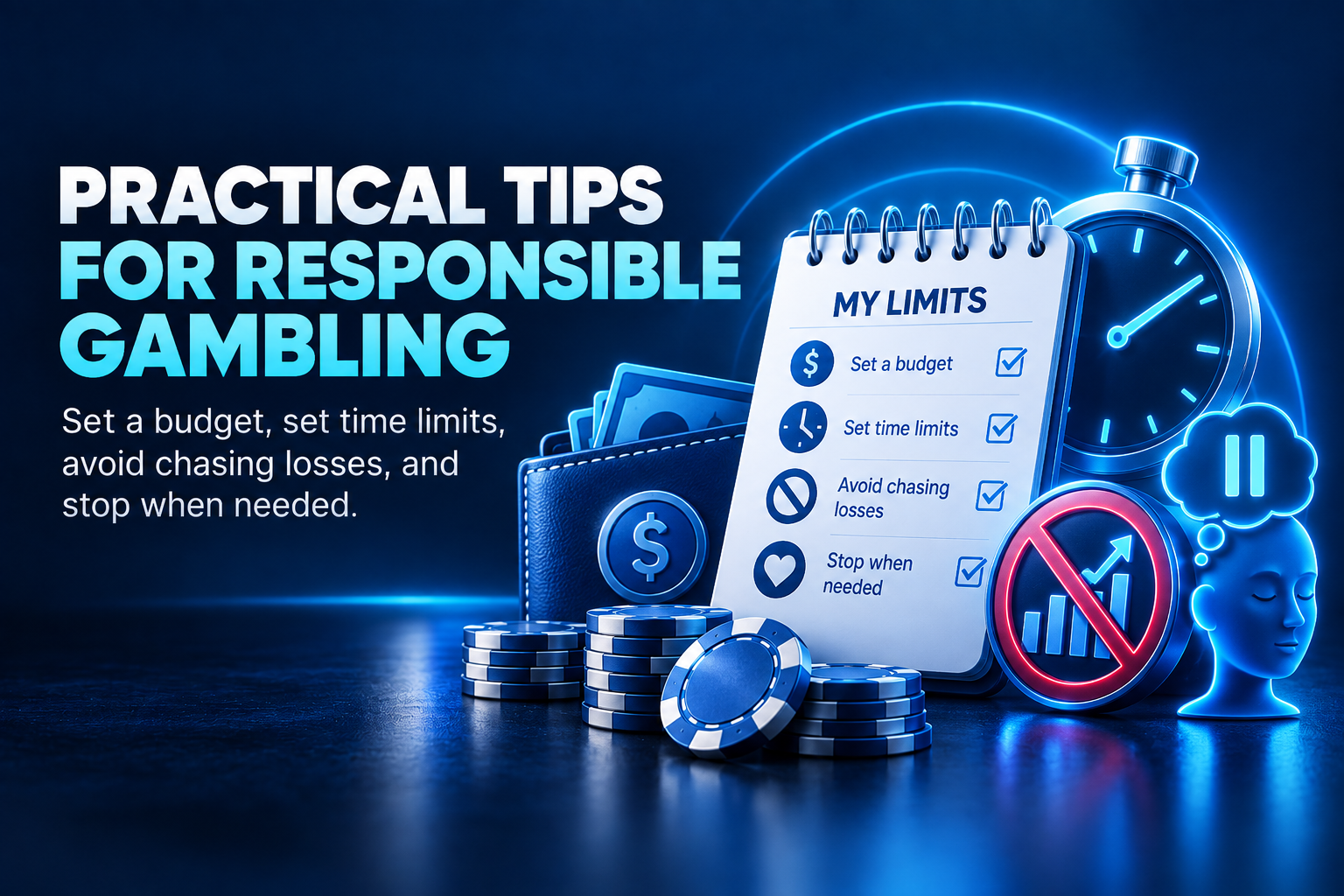
Responsible gambling involves managing both money and time.
Set a Gambling Budget
Set a clear gambling budget before placing bets or playing games.
That budget should be separate from money required for:
Everyday living
Bills
Rent
Food
Savings
Debt repayments
Emergencies
Users may consider setting daily, weekly, or monthly limits.
Once a personal limit has been reached, stop rather than increasing the budget in an attempt to recover losses.
Set Time Limits
Users should also monitor how much time they spend gambling.
Helpful practices may include:
Setting a time limit before starting
Taking regular breaks
Avoiding long continuous sessions
Logging out after reaching a predetermined limit
Keeping gambling separate from work, study, and family time
If gambling regularly takes more time than intended, consider taking a longer break.
Do Not Chase Losses
Chasing losses occurs when someone continues gambling or increases stakes in an attempt to recover money already lost.
There is no guarantee that the next bet or game will produce a win.
Increasing stakes after losing can result in further losses.
A more responsible approach is to accept the result and stop when necessary.
Do Not Borrow Money to Gamble
Borrowing money to gamble increases financial risk.
Users should not gamble using:
Loans
Money borrowed from friends or family
Funds needed for household expenses
Emergency savings
Money reserved for debt repayment
Credit intended for essential costs
Gambling losses should not create financial obligations that must later be repaid.
Avoid Gambling When Judgment Is Impaired
Alcohol, drugs, fatigue, stress, and strong emotions can affect judgment and decision-making.
Users should avoid gambling when their ability to make considered decisions may be impaired.
This can include periods of:
Anger
Stress
Anxiety
Frustration
Strong excitement
Emotional distress
Intoxication
Impulsive decision-making can increase financial risk.
Responsible Gambling Tools
Online gambling platforms may provide account-management tools intended to help users control gambling activity.
The availability, names, limits, and operation of these tools can vary by operator and jurisdiction.
Potential tools may include:
Deposit Limits
Deposit limits may restrict how much money can be added to an account over a specified period.
Loss Limits
Some platforms may allow users to set limits on how much they are prepared to lose over a defined period.
Wagering Limits
Wagering limits may restrict the total amount that can be bet over a particular timeframe.
Time Limits
Some platforms may provide tools that limit session duration or gambling frequency.
Reality Checks
Reality-check features may remind users how long they have been gambling and may display account or session information.
Cooling-Off Periods
Cooling-off features may temporarily restrict access to gambling services.
Self-Exclusion
Self-exclusion may allow users to restrict access to gambling services for a longer period.
The duration and scope of self-exclusion depend on the operator and jurisdiction.
Users should verify the current responsible gambling tools available directly through the relevant official platform.
Recognizing Potential Gambling Problems
Harmful gambling behavior can develop gradually.
Potential warning signs may include:
Spending more money than intended
Gambling for longer than planned
Frequently increasing stakes
Chasing losses
Hiding gambling activity
Borrowing money to gamble
Missing payments because of gambling
Feeling distressed when unable to gamble
Thinking about gambling constantly
Neglecting work, education, or relationships
Gambling to escape personal or emotional problems
Repeatedly trying to stop without success
Experiencing one or more warning signs may indicate that gambling is no longer purely recreational.
Recognizing the issue early and reducing or stopping gambling may help prevent further harm.
When to Stop Gambling
Users should consider stopping gambling if it begins to affect:
Financial stability
Emotional wellbeing
Personal relationships
Employment
Education
Daily responsibilities
It may also be appropriate to stop if:
Gambling no longer feels recreational
Losses repeatedly lead to attempts to win money back
Personal limits are regularly ignored
Gambling causes stress, conflict, or secrecy
Gambling becomes difficult to control
Stopping gambling completely is always a valid choice.
Seeking Support
If controlling gambling becomes difficult, consider speaking with someone you trust or seeking support from an appropriate gambling-support organization in your country or jurisdiction.
Independent support services may provide information relating to:
Gambling behavior
Financial management
Self-exclusion
Account restrictions
Counselling
Recovery support
Users may also contact the relevant gambling operator directly to ask about:
Deposit limits
Time limits
Cooling-off options
Self-exclusion
Account closure
This website does not provide medical, psychological, financial, or legal treatment.
Protecting Minors
Online gambling is intended only for adults who meet the legal gambling age applicable in their jurisdiction.
Minors should not be allowed to access gambling accounts or participate in online gambling.
Adults can help reduce unauthorized access by:
Keeping usernames and passwords private
Avoiding saved login details on shared devices
Using parental controls where appropriate
Securing payment information
Logging out after gambling sessions
Users should verify the minimum legal gambling age that applies in their jurisdiction. For information about how this website handles personal information and requests involving minors, see our Privacy Policy.
Responsible Use of Bonuses and Promotions
Bonuses and promotions may encourage users to deposit or wager more than originally intended.
Before considering a promotion, users should review relevant conditions such as:
Minimum deposit requirements
Wagering requirements
Minimum odds
Eligible games or markets
Expiration periods
Withdrawal restrictions
Maximum qualifying amounts
Regional restrictions
Payment-method exclusions
A promotion should never be a reason to exceed a personal gambling budget.
Bonus availability does not eliminate gambling risk and does not guarantee profit.
Responsible Use of Betting Guides
This website may publish:
Betting guides
Odds explanations
Market descriptions
Statistical information
Educational betting content
These resources are intended to help readers understand betting products and terminology.
They do not guarantee winning outcomes.
Historical results, statistics, trends, predictions, or analysis should never be interpreted as certainty.
How We Review Responsible Gambling Information
Responsible gambling is an important part of our editorial approach when covering 1xBet. Our Editorial Policy describes how the website evaluates sources, verifies information, and handles corrections.
Based on publicly available or official information where available, we may examine whether the platform provides or describes features such as:
Deposit limits
Loss limits
Wagering limits
Time limits
Reality checks
Cooling-off options
Self-exclusion
Account closure procedures
Responsible gambling information
Support resources
We may also examine how clearly responsible gambling information is presented and whether relevant controls are reasonably accessible.
However, the availability of responsible gambling tools does not eliminate gambling risk.
Features and policies can change, so users should independently verify current tools and procedures through the official platform.
This Website Is Not 1xBet
This website is an independent informational and editorial resource about 1xBet. For details about the publisher and its independent status, see our About Us page.
We do not operate 1xBet or any other sportsbook, casino, betting exchange, payment service, or gambling account system.
We cannot:
Place or cancel bets
Access player accounts
Accept or control deposits
Approve or process withdrawals
Set gambling limits
Activate self-exclusion on 1xBet
Close 1xBet accounts
Change account restrictions
Modify platform policies
Access private account information
If you need to change gambling limits, close an account, request self-exclusion, or resolve an account-specific issue, contact 1xBet through its current official support channels. For questions or corrections about content published by this independent website, use our Contact page; our editorial team cannot handle platform account issues.
Editorial Standards for Responsible Gambling
Our editorial content should not claim or imply that:
Gambling is risk-free
Winnings are guaranteed
A betting strategy guarantees profit
Losses can always be recovered
A bonus guarantees financial benefit
A bookmaker or casino guarantees financial success
Gambling can reliably solve financial problems
Where appropriate, reviews and guides may include responsible gambling reminders and information about relevant risks.
Affiliate or commercial relationships do not change these editorial principles. The profile for Briana Acosta identifies the author responsible for the website's published articles.
Before Choosing to Gamble
Before using a gambling platform, adults should consider:
Whether gambling is legal in their jurisdiction
Whether they meet the applicable legal age
Whether they can afford to lose the money they intend to wager
Whether gambling remains recreational and within personal limits
If these conditions are uncertain, choosing not to gamble is a valid option.
Our Responsible Gambling Commitment
Our responsible gambling approach is based on a simple principle:
Gambling should remain controlled, affordable, legal, and recreational.
We encourage readers to understand the risks, establish personal limits, take regular breaks, use responsible gambling tools where appropriate, and stop gambling if it begins to negatively affect finances, relationships, responsibilities, or wellbeing.