Is 1xBet Safe? Licence, Legitimacy and Risk Review
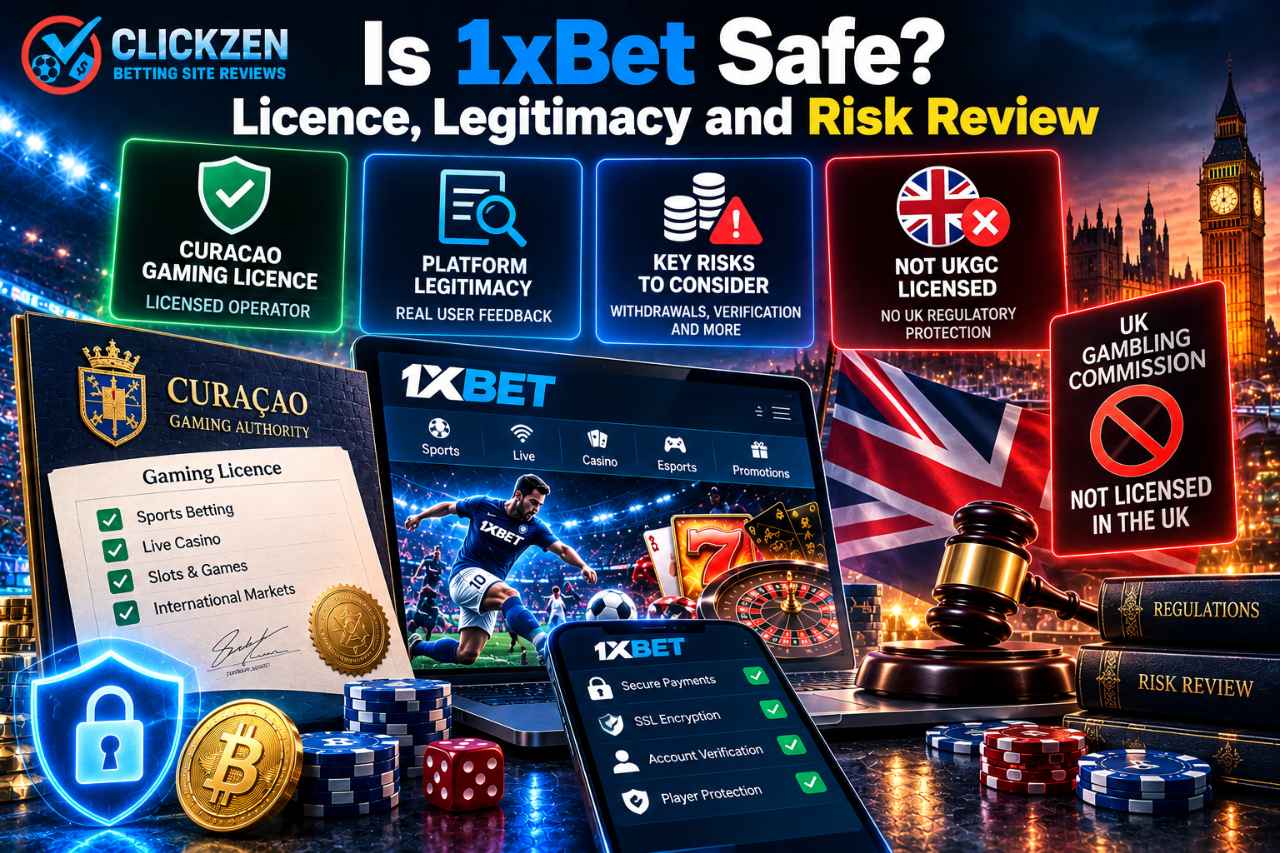
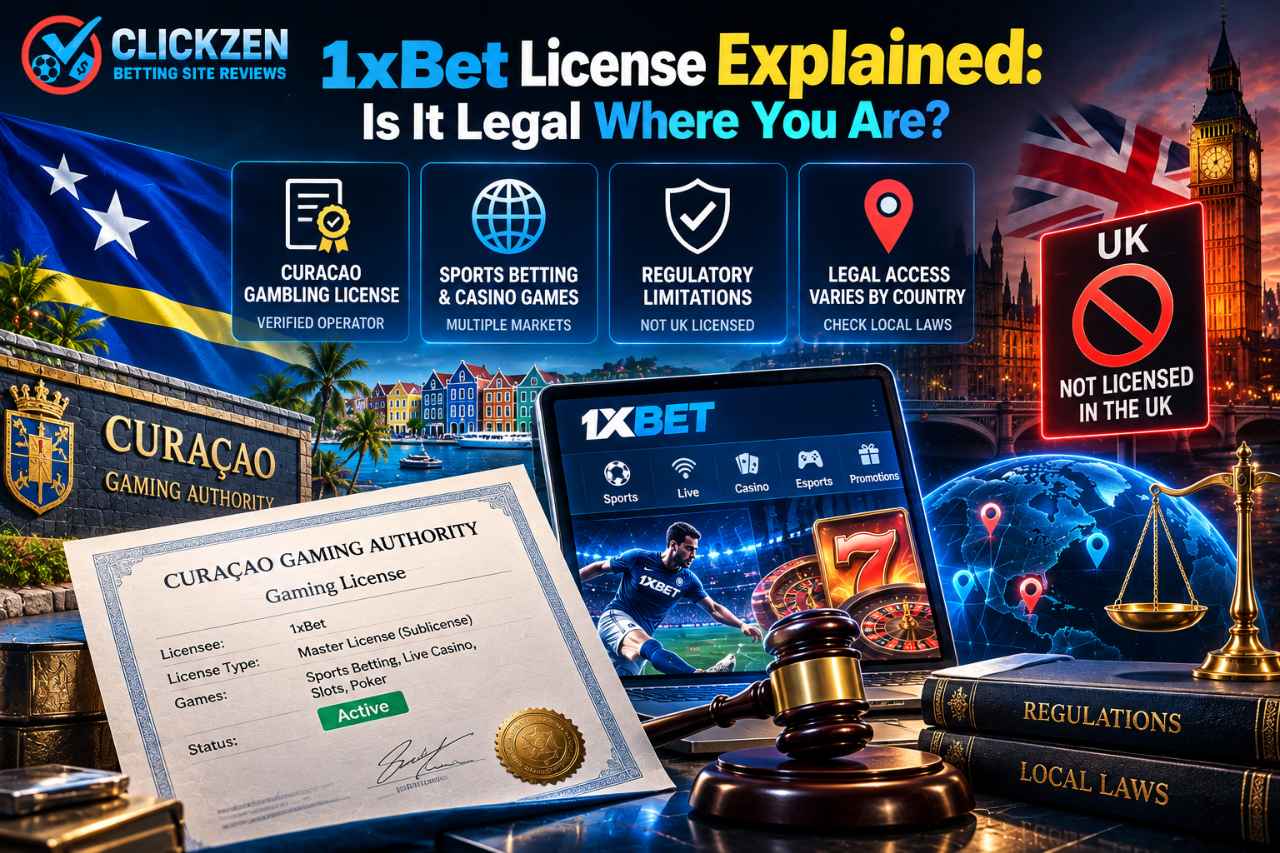
1xBet operates as a licensed sports betting and casino platform rather than a scam operation, holding a licence that permits it to serve international markets. 1xBet operates under a Curacao gaming licence, though the specific licence number and issuing authority are not independently confirmed here. That licence status does not automatically make every feature or regional offering risk-free, which is why the sections below break down licensing, user feedback and fund protection separately.
1xBet does not hold a licence from the UK Gambling Commission. 1xBet is not included among the operators licensed by the UK Gambling Commission, so it cannot legally accept bets from UK-based customers under current rules. UK users who access the site through alternative domains fall outside the protections that a UKGC licence would normally provide.
User reviews of 1xBet found online are mixed, with complaints more often focused on withdrawal delays and account verification issues than on confirmed cases of fund theft. These patterns suggest an operational platform with service gaps rather than a fraudulent one.
1xBet protects user funds and data through SSL encryption and segregated payment processing. 1xBet states that it uses encryption and account verification measures for transactions, consistent with general safeguards for licensed online bookmakers, though the specific encryption standard and fund segregation method are not independently confirmed here.
The next sections on 1xbet.clickzen.io examine how these claims hold up against licensing records and real user experiences, starting with whether 1xBet qualifies as a safe and legitimate betting platform overall. That verdict rests on a Curacao licence, the absence of UK Gambling Commission authorisation, and a mixed volume of user complaints.
Is 1xBet a safe and legitimate betting platform?
 Is 1xBet a safe and legitimate betting platform
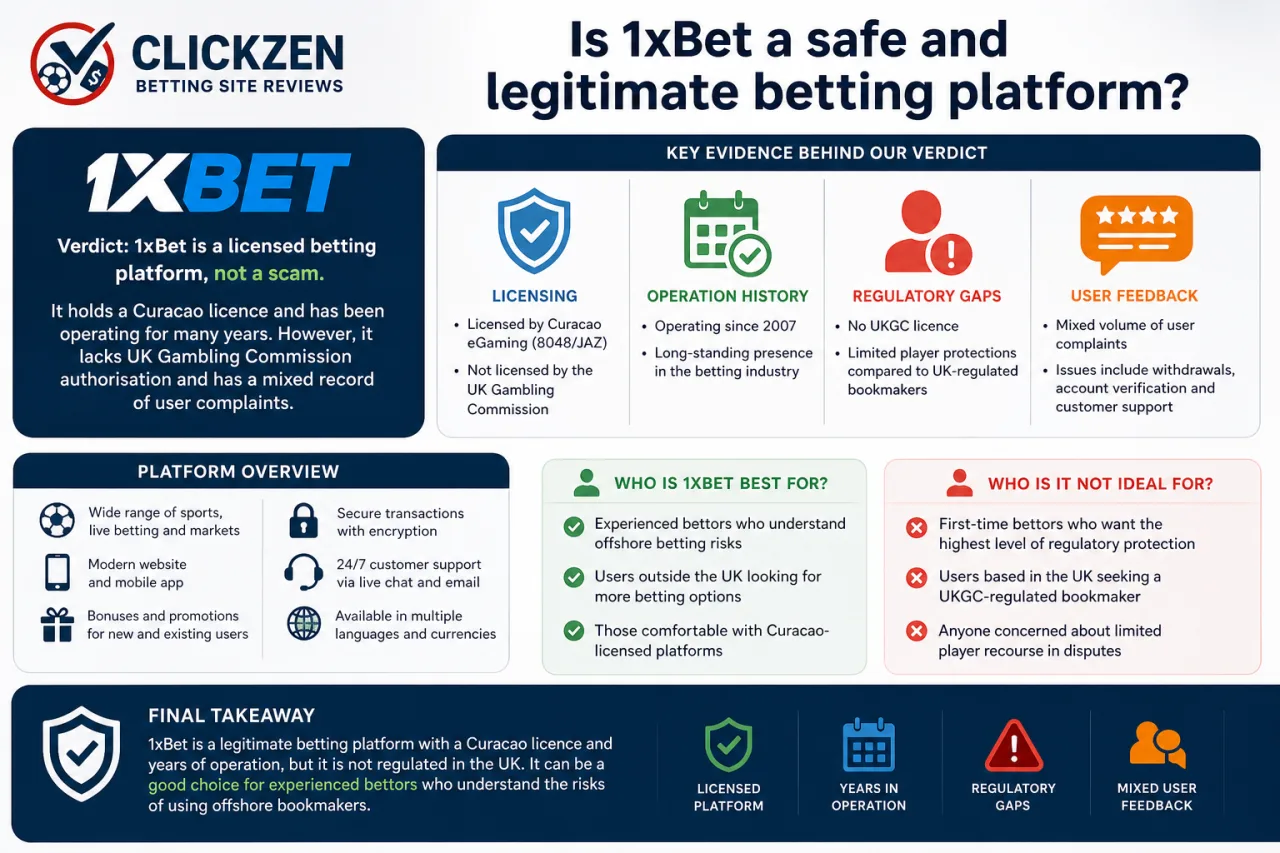
1xBet qualifies as a licensed betting platform rather than a scam, though it carries regulatory gaps that make it a better fit for experienced bettors than first-time users seeking a UK-regulated site.
That verdict rests on an active Curacao licence, the absence of UK Gambling Commission authorisation, and a mixed volume of user complaints. The following breakdown covers licensing, legitimacy indicators and user experience as separate pieces of evidence behind this call.
1xBet operates under a Curacao gaming licence, which keeps it accessible to international bettors but excludes it from UK Gambling Commission oversight. This offshore status is the main reason the platform remains open to markets that UK-regulated sites cannot serve.
The main risk factors are the lack of UK licensing (covered above), reliance on a single offshore regulator, and recurring withdrawal and verification complaints rather than theft reports. These gaps matter more for users who expect UK-level consumer protection or fast dispute resolution through a local regulator.
1xBet suits bettors in jurisdictions where it operates legally and who accept offshore licensing terms, extensive market coverage and the verification steps that come with a Curacao-regulated operator. It is a weaker match for UK-based users or anyone prioritising a regulator with direct enforcement power over local complaints.
Is 1xBet licensed and regulated in the UK?
 Is 1xBet licensed and regulated in the UK
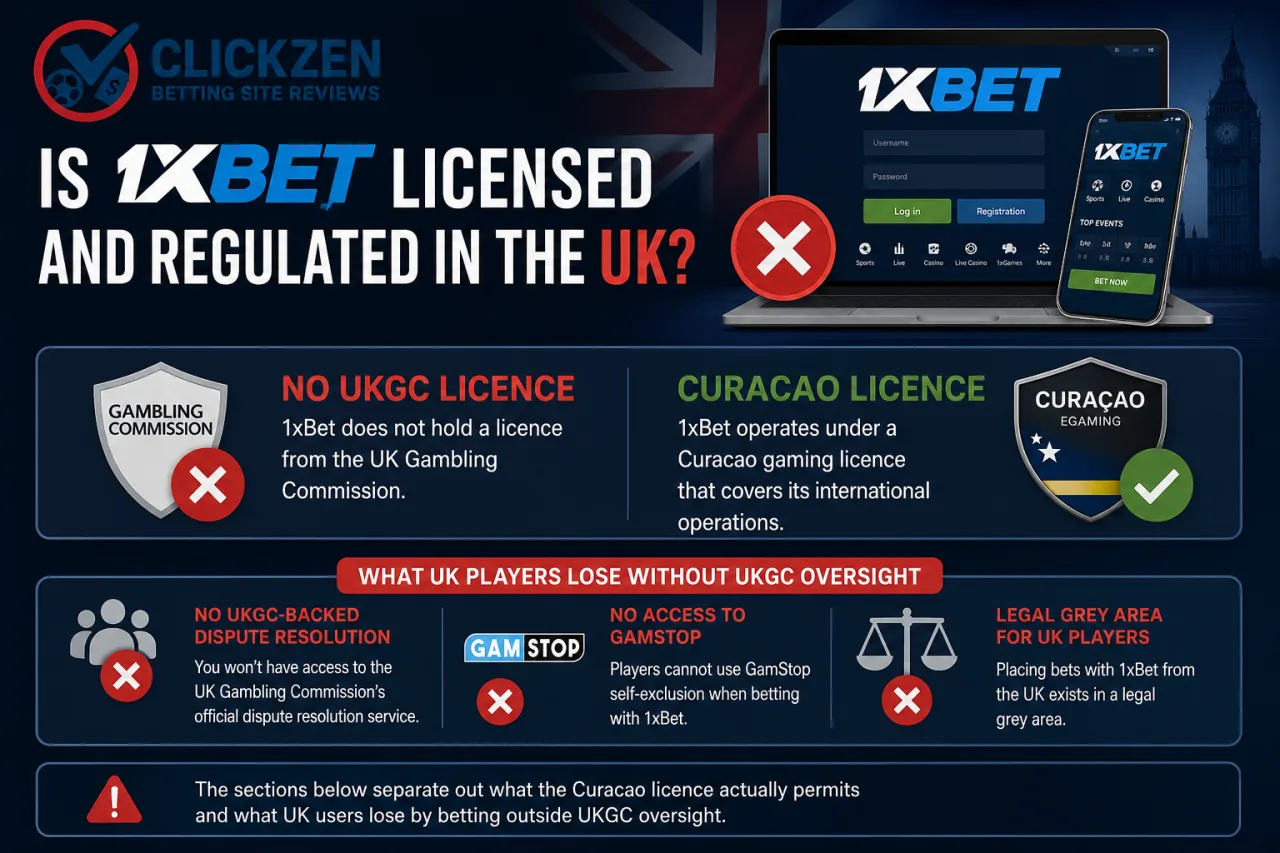
1xBet does not hold a licence from the UK Gambling Commission, and instead operates under a Curacao gaming licence that covers its international operations. Curacao's licensing framework differs structurally from the UKGC model, with oversight and enforcement that work differently from what UK-licensed operators are subject to.
That gap carries direct consequences for UK bettors. There is no UKGC-backed dispute resolution, no access to GamStop self-exclusion, and a legal grey area for anyone placing bets from the UK.
The sections below separate out what the Curacao licence actually permits and what UK users lose by betting outside UKGC oversight.
What licences does 1xBet hold outside the UK?
Outside the UK, 1xBet relies on a Curacao gaming licence as its primary form of regulatory cover, a model common among offshore-facing bookmakers. That licence confirms the operator is registered and permitted to take bets internationally, but it sits well below the oversight standard set by the UKGC or Malta's MGA.
1xBet's Curacao authorisation has historically operated under the jurisdiction's older master licence system, where a central licence holder could cover multiple sub-brands and domains, a structure Curacao has since moved away from as part of its licensing reform.
A Curacao licence differs from UKGC or MGA authorisation in three practical ways:
Dispute resolution runs through the licensing authority or an appointed mediator rather than a national ombudsman with enforcement power.
Financial audits and player-fund segregation checks are less frequent and less publicly disclosed than under UKGC rules.
Advertising standards and responsible-gambling requirements are lighter, with no equivalent to GamStop built into the licence.
This means a Curacao licence verifies that 1xBet operates legally in permitted markets, without matching the consumer-protection depth that UKGC or MGA licensing provides.
Is 1xBet legit or a scam based on user reviews?
 Is 1xBet legit or a scam based on user reviews
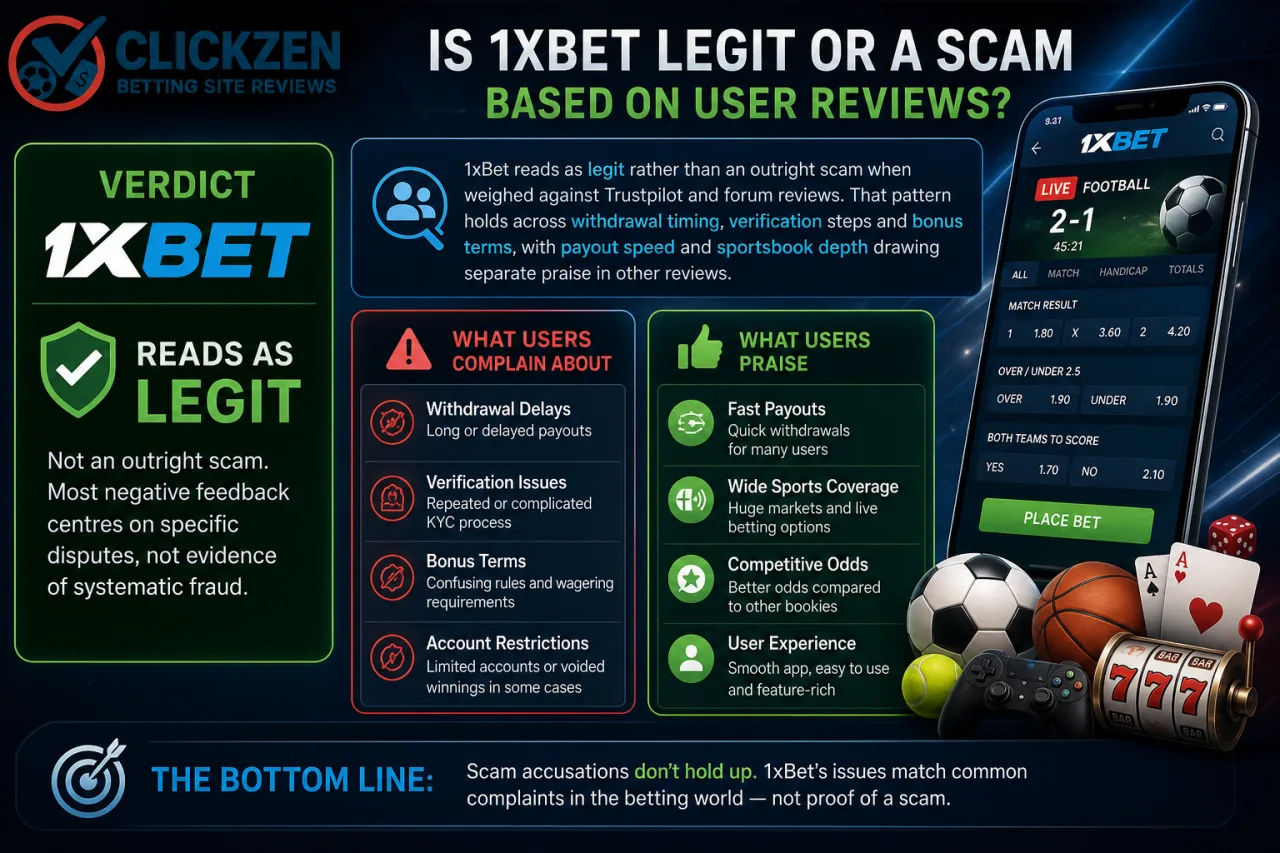
1xBet is legit, not a scam, based on Trustpilot and forum reviews, though complaints exist over specific disputes. That pattern holds across withdrawal timing, verification steps and bonus terms, with payout speed and sportsbook depth drawing separate praise in other reviews. The breakdown below splits complaint types from positive feedback before looking at how scam accusations actually hold up.
What are the most common complaints against 1xBet?
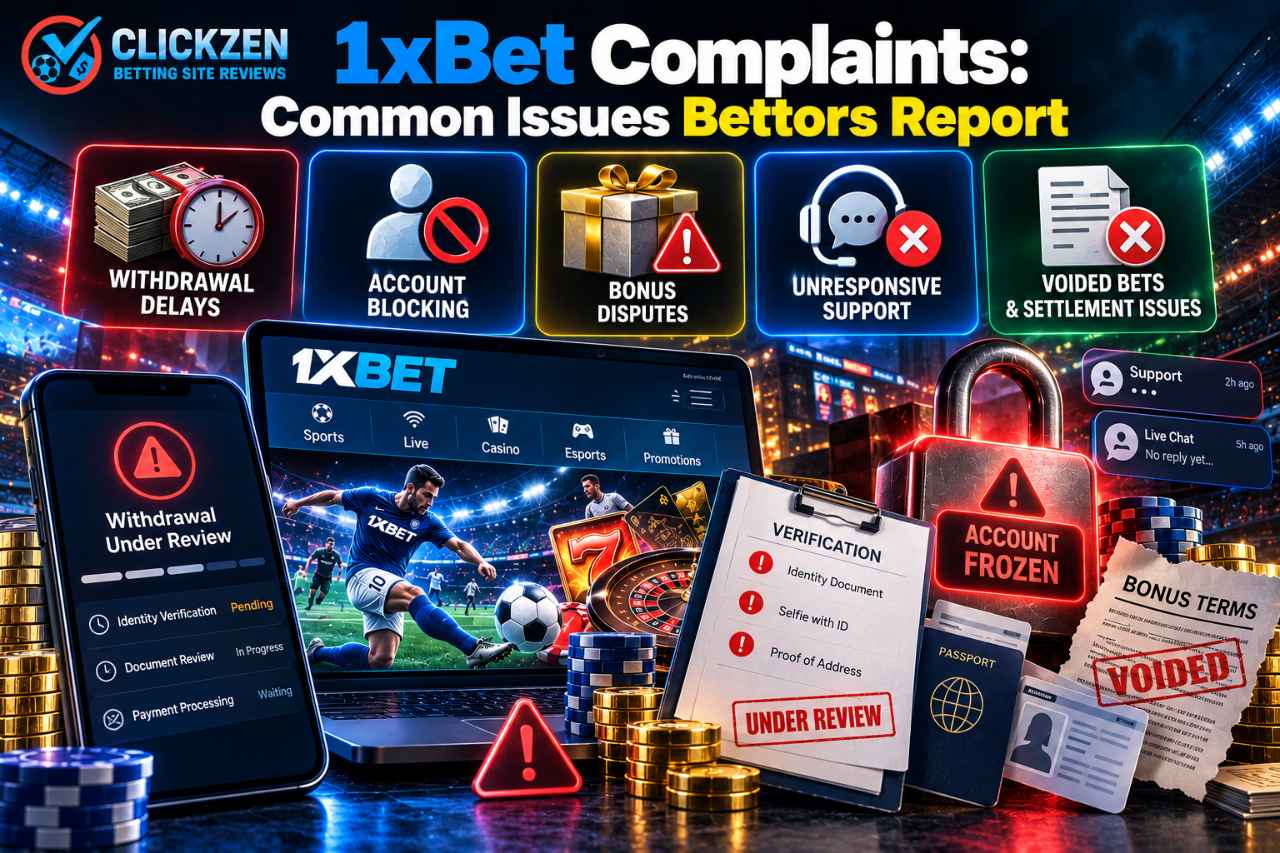
Recurring complaints against 1xBet fall into five groups: delayed withdrawals, KYC and document verification friction, frozen accounts, bonus terms disputes, and slow customer support responses. These categories repeat across review platforms and forum threads rather than appearing as isolated incidents, which is why the previous breakdown treats them as the core complaint pattern rather than one-off grievances.
Delayed withdrawals: some users report payout processing that takes longer than expected, particularly for e-wallet and bank transfer methods.
KYC and document verification friction: accounts get flagged for additional identity checks after a withdrawal request, sometimes requiring repeated document submissions before funds release.
Frozen accounts: a subset of complaints describe accounts locked mid-withdrawal, with the stated reason tied to verification or terms-of-service review rather than confirmed fraud.
Bonus terms disputes: wagering requirements and qualifying bet conditions attached to welcome offers lead to rejected withdrawal requests when users misread the terms.
Customer support responsiveness: live chat and ticket-based support draw complaints about long reply times when a dispute involves a frozen account or rejected bonus.
None of these categories, on their own, confirm the fund-theft accusations that sometimes surface in isolated reviews.
How does 1xBet protect user funds and personal data?
 How does 1xBet protect user funds and personal data
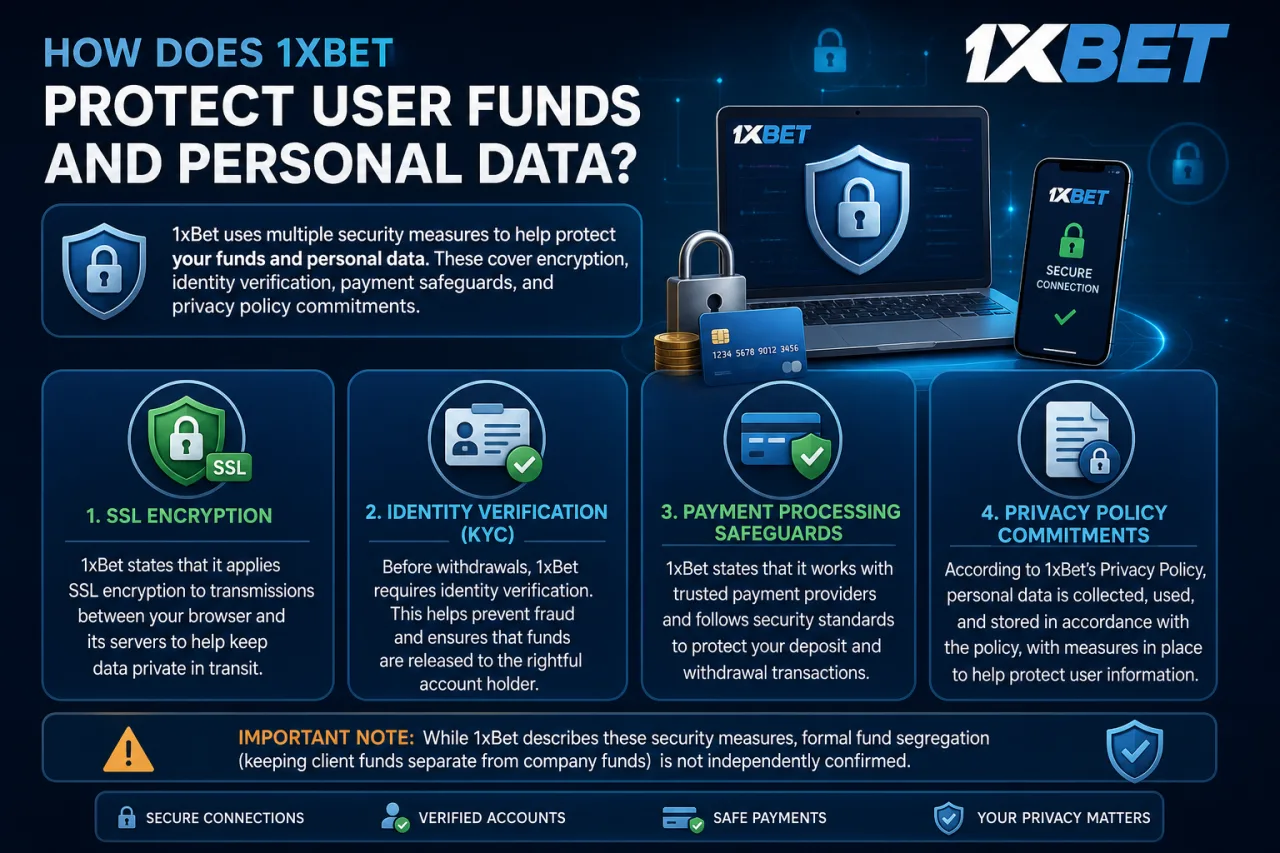
1xBet protects user funds and personal data through a combination of SSL encryption, identity verification checks and stated payment-processing safeguards, though formal fund segregation is not disclosed in public materials. That combination covers four areas worth separating out: encryption on the site, the KYC process tied to withdrawals, how payment methods get secured, and what the privacy policy says about personal data handling.
1xBet states that it applies encryption to transmissions between the user's device and its servers, consistent with general security practices among licensed online bookmakers. The operator does not publish the specific encryption standard used on its platform.
Account verification works through a KYC process triggered mainly at withdrawal. Identity documents get requested before funds release, which matches the verification friction described in user complaints above.
Payment security relies on the card networks and e-wallet providers processing each transaction rather than a disclosed in-house fraud system. The privacy policy covers data collection and storage for registered accounts. The retention period and third-party data-sharing terms are not detailed in publicly available summaries.
What security measures does 1xBet use for payments and account access?
1xBet secures payments and account access through SSL encryption on data transmissions, optional two-factor authentication for login, and verified third-party payment channels rather than a single proprietary security system. That combination sits alongside the KYC checks described earlier, but covers a narrower, more technical layer: what happens at the point of login and at the moment money moves.
1xBet applies SSL-based encryption to the connection between a user's browser or app and its servers, matching standard practice among licensed online bookmakers, though the exact encryption protocol is not independently confirmed here.
Two-factor authentication is available as an account setting rather than a mandatory step at registration, giving users the option to add a secondary login code on top of their password.
Supported payment channels include bank cards, e-wallets and cryptocurrency processors, each handling transaction security through its own provider rather than through a 1xBet-built payment gateway.
Account login protections include password-based access combined with device or session checks that can prompt re-verification, consistent with the identity checks tied to withdrawals covered above.
How does 1xBet compare to UK-licensed bookmakers on trust and safeguards?
1xBet trails UK-licensed bookmakers on trust and safeguards because its Curacao licence skips UKGC-mandated dispute resolution, GamStop self-exclusion and the UK's stricter advertising rules. That gap sits on top of the licensing differences already covered above, but it carries separate consequences for everyday account protection and complaint handling. The breakdown below splits dispute access, self-exclusion tools and advertising oversight into their own points before weighing where each model leaves bettors better or worse off.
What protections do UK-licensed operators offer that 1xBet does not?
UK-licensed operators offer four protections absent from 1xBet: GamStop self-exclusion, Gambling Commission complaint escalation, mandatory affordability checks, and advertising standards enforcement. These sit on top of the licensing and dispute-resolution gaps covered above, but each works as a distinct safeguard rather than a general oversight difference.
GamStop self-exclusion: UK operators register with this national scheme, letting a user block their own access across every UKGC-licensed site at once, a feature 1xBet does not offer through its Curacao licence.
Gambling Commission complaint escalation: UK bettors can escalate an unresolved dispute to the regulator or an approved alternative dispute resolution body with enforcement power, rather than relying solely on the operator's internal process.
Mandatory affordability checks: UKGC rules require licensed operators to monitor a customer's spending for signs of financial harm and intervene when risk indicators are triggered, a check not built into 1xBet's Curacao-based verification process.
Advertising standards enforcement: UK-licensed bookmakers answer to the Advertising Standards Authority and UKGC marketing rules on bonus claims and responsible-gambling messaging, which do not apply to 1xBet's offshore-facing advertising.
Bottom line
A Curacao licence and years of operation rule out 1xBet as an outright scam, but the missing UKGC authorisation, absent GamStop link and recurring withdrawal complaints set the real decision point. UK-based bettors who want regulator-backed dispute resolution and self-exclusion tools have that only through UKGC-licensed sites, not here.
Users outside that jurisdiction who accept offshore terms should still complete KYC verification early and read bonus wagering conditions before depositing. Those two areas generate most of the documented complaints against 1xBet.

As CEO, Briana Acosta leverages over a decade of industry expertise to redefine smart gambling. She breaks down complex sports betting markets and online casino algorithms, equipping players with the professional bankroll management strategies needed for long-term, sustainable success.